ML Interview Notes
Open-source notes for machine learning interviews. From first principles to the systems that put them to work.
Courses
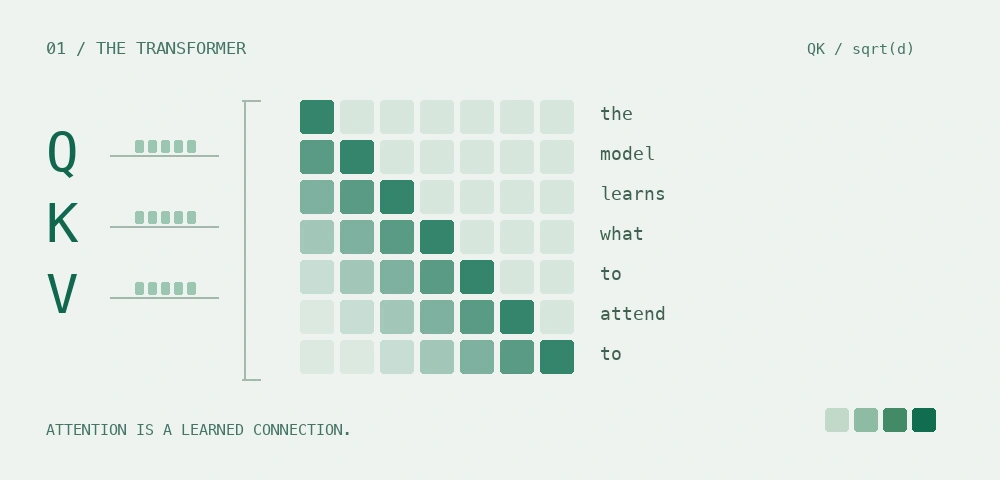
A sequential, build-from-scratch course on the Transformer architecture, from "why did we abandon RNNs?" through to the exact configuration choices in production models shipping in 2026.
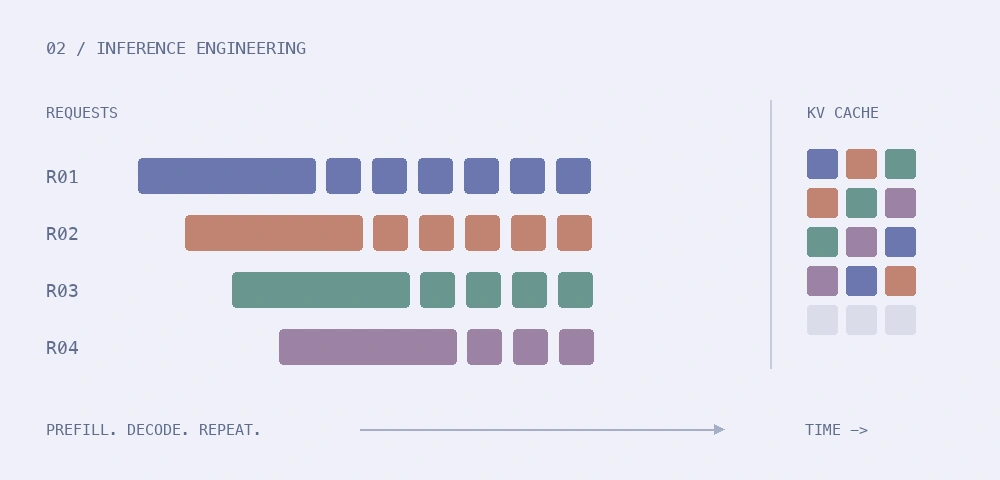
How LLM serving systems actually work, read out of the vLLM and SGLang source. Continuous batching, PagedAttention and RadixAttention, quantization, parallelism, speculative decoding, and how to benchmark any of it honestly.
Notes
Mathematical foundations for machine learning — linear algebra, calculus, probability, statistics, optimization, information theory, discrete mathematics, and numerical computing.
The Python stack for machine learning — NumPy, pandas, scikit-learn, PyTorch, TensorFlow, the boosting libraries, visualization, Hugging Face, and the MLOps tooling around them.
Core machine learning — framing a problem, the algorithm families derived from first principles, generalization theory, evaluation, feature engineering, tuning, and the practical and ethical failure modes.
Neural networks from the perceptron up — backpropagation, activations and initialization, optimization, normalization, CNNs, RNNs, transformers, transfer learning, generative models, self-supervised learning, and deep RL.
Natural language processing from tokenization to LLMs — representation, language models, classification and tagging, translation, generation and decoding, RAG, speech, and evaluation.
Contributing
An open collection, built by people who care about understanding. Contribute to the library